Legacy eDiscovery tools may introduce more risk than they mitigate.
There’s no question these tools solved problems for federal agencies when times were simpler. But data volumes and complexity are increasing, scrutiny is growing, and security expectations have changed.
The environment legacy tools were built for no longer exists, and that’s true from legal, IT, and government perspectives. All of these angles point to the importance of modernization.
Why Legacy Tools Have Become a Persistent Government Risk
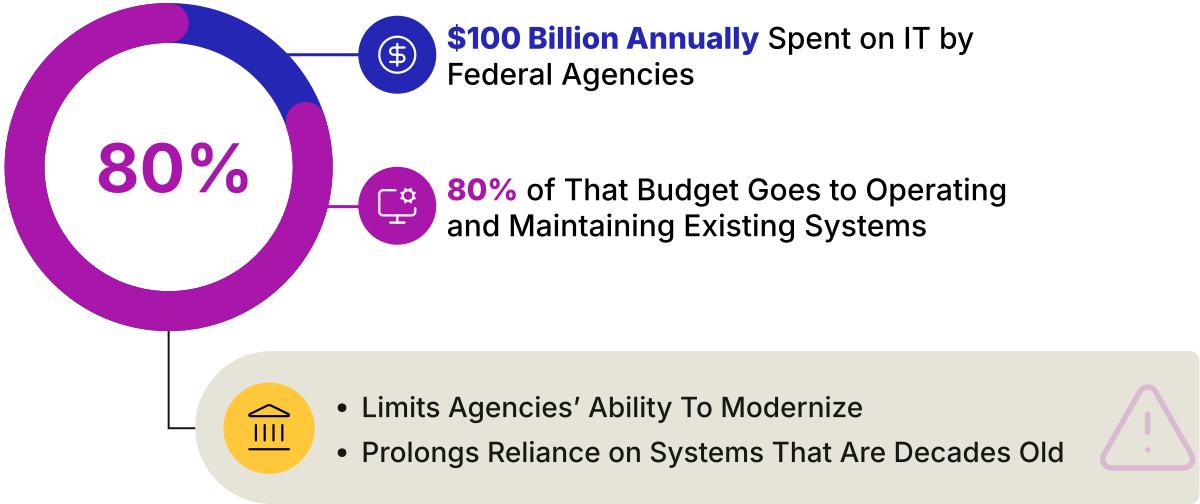
According to the U.S. Government Accountability Office (GAO), federal agencies spend more than $100 billion on IT annually. Roughly 80% of that is for operating and maintaining existing systems, “including aging ‘legacy’ systems that are costly to maintain and vulnerable to hackers.” The GAO has warned that this limits agencies’ ability to modernize while prolonging reliance on systems that are decades old. In some cases, the legacy systems are more than 50 years old.
The challenges extend well beyond core IT systems. Historically, agencies have implemented individual tools on a case-by-case basis to solve narrow problems rather than as part of a unified strategy. Federal oversight has consistently flagged this pattern more broadly, with GAO noting in a separate report on fragmentation and duplication that piecemeal technology investments remain a government-wide issue.
Instead of coordinated systems, the incremental tool-by-tool adoption approach across many government agencies results in overlapping capabilities.
How the Pattern Applies to eDiscovery and Other Legal Tools
Consider why legacy eDiscovery, FOIA, and legal hold tools were acquired originally. In many situations, it was a response to specific mandates, court deadlines, or compliance requirements. In other words, an immediate solution. Speed, not long-term enterprise alignment, was often the priority.
Legacy tools weren’t designed for the coordination and visibility that modern legal work now requires. And yet, as you’ve read here and likely in several other places, demands have grown across data volumes, data sources, distributed teams, defensibility, and security.
Take a look at some examples across three major types of legal tools.
-
eDiscovery: Look at what’s happening to on-prem tools. The blog As Relativity Retires Support for Server, Federal Agencies Enter a Cloud-First, Security-First Era highlights how the upcoming sunset is forcing agencies to reassess whether on-prem and other legacy tools can meet modern operational and security requirements. Industry trends point to a resounding “no.”
-
FOIA: Staff reductions and office closures exacerbate the disconnected workflows and shortcomings of basic digital tools and manual systems. The blog The Future of FOIA: Secure, Fast, and Transparent outlines these issues and shows how eDiscovery can manage every part of the FOIA process.
-
Legal Hold: A lot of agencies still use simple tools or even spreadsheets to manage legal holds. The additional time and risk can be substantial. With a modern platform that connects to eDiscovery functionality, the legal hold process can make everything more manageable and effective. Take a look at how automation, templates, reporting, and more can help in the whitepaper Boost Custodian Compliance Rates for Legal Holds.
The Case for a Cohesive Legal Strategy (And What It Means for eDiscovery)
At first glance, the need for a cohesive legal strategy seems obvious. But it’s also easy to see how agencies arrive at a patchwork of legacy tools.
Contracting timelines can stretch for years, and once a system is in place, momentum builds. Over time, incremental decisions add up. And before you know it, an agency finds itself relying on tools that are decades old, much like those highlighted in the GAO’s report. Their recommendation was clear: modernization is the only path forward.
That’s true for eDiscovery too. Let’s take a look at some core non-negotiables, and examples of what that looks like with Casepoint’s platform.

-
Security: The level of classification, compliance documentation, and formal authorization required makes security a critical consideration for agencies, especially as breaches continue to rise. Look for leading data security standards like FedRAMP® High, DOD IL5/IL6. Casepoint is the only platform in the industry to hold any of these authorizations.
-
Cloud Access and Accessibility: Legal teams need to access the platform across locations and agencies, without navigating on-prem infrastructure or delayed upgrades. Collaboration combined with security was a key motivator for the U.S. Department of the Air Force when modernizing their tech stack with Casepoint.
-
Unified Platform: Combining eDiscovery with FOIA and legal hold reduces silos and limits data risk. The result is a data discovery platform that can handle complex legal, investigatory, and compliance needs across the board.
-
Connectors and Automation: The ability to pull from multiple data sources automatically reduces manual effort and helps teams keep up with expanding data types. Casepoint processes more than 600 data types that seamlessly and automatically connect to applications, cloud-based data repositories, collaboration tools, and email databases.
So many factors make the cost of legacy tools hard to ignore. When modernization is part of a cohesive legal strategy, agencies can move beyond outdated, fragmented tools and toward long-term resilience.

Author
Senior Content Writer
Brian Neese is the Senior Content Writer at Casepoint, leading the strategy and development of thought leadership and marketing content that helps legal and government professionals connect with transformative technology. He brings more than 15 years of experience across technology, higher education, finance, and retail, including collaborations…
Categories:


