
A note from Krystal Putman-Garcia on why Casepoint refreshed its brand, what changed, and what it means for the teams we serve.
Most brand refreshes in this industry follow a familiar script. New logo, earnest post about the journey, some language about being bold and forward-thinking, and a promise that everything is about to change. You have probably read that version recently. This is not it.
Casepoint has described itself as a platform company for years. That part is not new. What is new is that every pillar of that platform has reached a level of depth and capability that makes the word “platform” mean something different.
Our competitors are catching up to the language. They have not caught up to the reality.
The Platform Has Always Been the Strategy — Now the Depth Is Clear
Casepoint launched as a cloud-native eDiscovery platform before the legal market was ready to leave on-premises systems behind. That early bet proved right, and eDiscovery remains the strongest and most battle-tested foundation in what we do. That foundation continued to evolve.
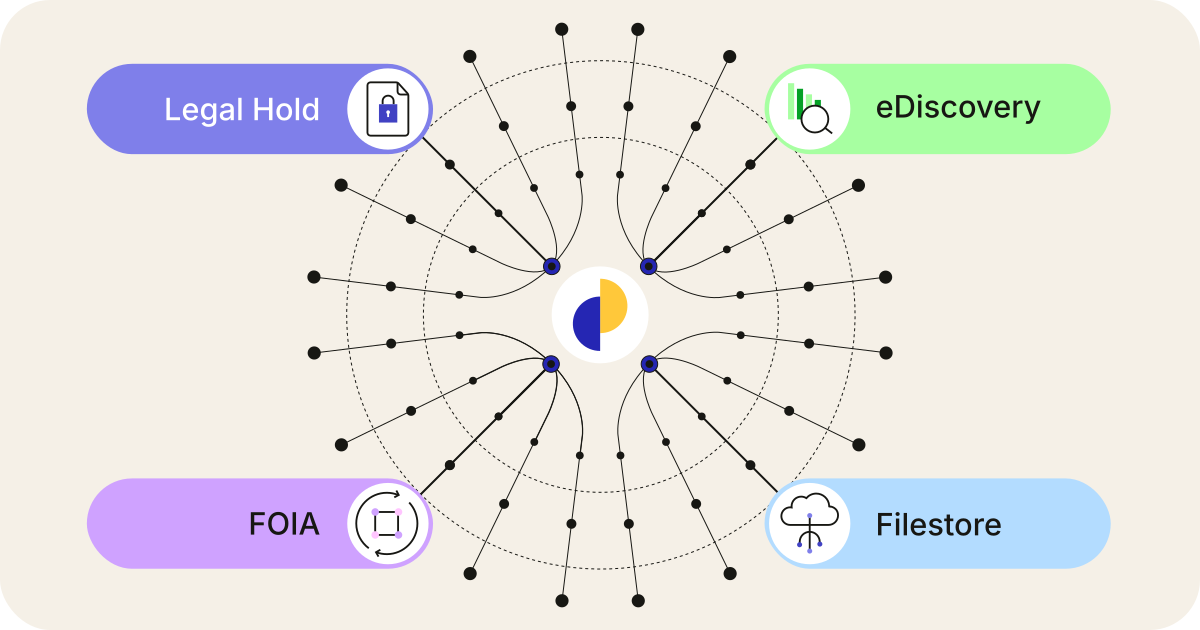
Over time, Casepoint built out genuine capability in legal hold, investigations, FOIA, and legal data management — not as adjacent products loosely integrated, but as solutions that share the same data architecture, the same security model, and the same audit trail. The platform today covers a range of work that few legal and compliance teams fully realize is available to them: litigation discovery, legal hold, internal investigations, regulatory oversight, government investigations, DSAR response, cybersecurity breach response, third-party subpoena responses, FOIA request management, congressional inquiries, and declassification reviews.
Those are not theoretical capabilities. They are the actual matters our customers bring to us every day. The brand refresh is, in part, an acknowledgment that we owe it to our customers — and to the teams who may soon become our customers — to describe the platform accurately.

What Each Pillar Looks Like in Practice
-

Legal hold
Casepoint Legal Hold is not a checkbox feature built to round out a product catalog. Over the past year alone, the solution added more than 100 new and enhanced capabilities, including task-based request management, expanded custodian tracking, automation templates, and advanced reporting built for the scrutiny that legal holds actually face in litigation and regulatory contexts. Teams that started with Casepoint for eDiscovery are frequently surprised by how much the legal hold capability has matured. They should not have to be surprised. That is part of what the brand refresh is correcting.
-

eDiscovery
The eDiscovery engine has not stood still either. New audio and video transcription capabilities, expanded enterprise data connectors, updated processing support for modern file types, including Apple formats, and an investigations module that surfaces connections between persons of interest and relevant data. This is where Casepoint built its reputation, and it remains the most complete and defensible solution in the market. The difference now is that it operates as one piece of a larger whole rather than the beginning and end of the story.
-

FOIA
Casepoint FOIA is the forward edge of what government transparency technology can be, and it goes considerably beyond what the market currently offers. A complete FOIA solution should handle the full lifecycle: a requestor-facing portal, native integrations with pay.gov, foia.gov, and login.gov, AI and generative AI tools that help requestors scope submissions before they are filed, full case management from intake through final response, and eDiscovery built directly into the review workflow rather than bolted on from a separate system. That is what Casepoint FOIA delivers: purpose-built for the way agencies actually operate, informed by decades of experience serving the government transparency community. The result is a solution that reduces unnecessary requests, accelerates response times, and keeps the entire FOIA process in one defensible environment.
-

Filestore (Data Management and Storage)
Underneath all of it is Casepoint Filestore™ — secure, scalable cloud data management that serves as the legal data compliance and storage foundation for every workflow on the platform. Keeping data preserved, accessible, and defensible throughout the entire matter lifecycle is not a feature. It is the infrastructure that makes everything else work without requiring data to move across systems, vendors, or environments. Every handoff you eliminate is a gap in the chain of custody you never have to explain.


Why Unification Changes the Defensibility Equation
Fragmentation in legal and compliance technology creates operational inconvenience and real risk. When audit trails fracture across systems, when data transfers between vendors, and when teams reconstruct the same record in multiple tools, defensibility erodes when it matters most. Courts, regulators, and oversight bodies do not grade on a curve for complexity. They expect a complete, consistent, and explainable record.
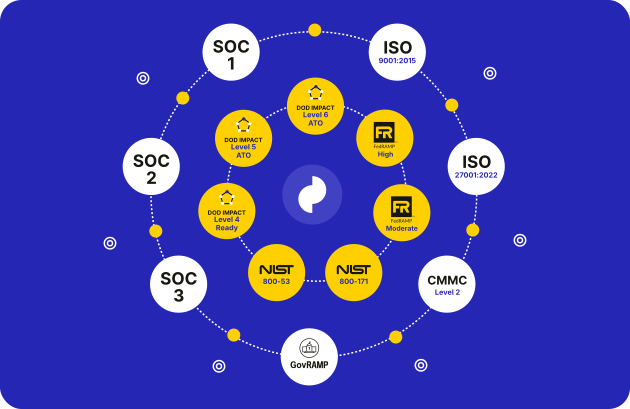
Casepoint's security infrastructure makes the unified model possible at the highest sensitivity levels, including FedRAMP® High, DOD Impact Level 5 (IL5) and IL6 authorizations, and CMMC Level 2 compliance. We are the only legal technology provider authorized at DOD IL5 and IL6 — one of just six cloud providers globally at that level, alongside Amazon, Google, Microsoft, Oracle, and Palantir.
That is the reason government agencies and Fortune 500 legal teams can run the full spectrum of sensitive workflows inside a single controlled environment, without security exceptions, data transfers, or additional vendor assessments for each new use case.
What the Brand Refresh Actually Changed
The visual identity is cleaner. The core idea of turning complexity into clarity and building systems to simplify the complex reflects an operational promise, not an aspiration. The most meaningful change is how the language we use to describe what the platform covers, and the ambition behind it.
For years, eDiscovery was the right entry point for most conversations about Casepoint because it was where most customers started. It remains an accurate and important part of the story, but it is not the whole story, and leading with it alone undersells what the platform has become.
What did not change is how we work with customers. Partnership, and not a service model, has always been central to how Casepoint operates and is built. From the first conversation about a team's challenges and desired outcomes through implementation and the work that follows, Casepoint stays close.
The platform roadmap is driven in large part by customer feedback. That is not a talking point: More than 60% of product updates over the past year came directly from what customers told us they needed. The brand refresh sharpens how we present ourselves externally. The way we actually show up for customers has not changed.
What This Means If You Work With Us
Operationally, nothing changes. Your contracts, your support team, your implementation, and your roadmap commitments all remain in place. What the refresh signals is that the platform you are running on has more reach than many teams currently use.
Organizations that started with eDiscovery often do not realize the depth of the legal hold capability sitting alongside it. Government teams managing FOIA requests, congressional inquiries, or agency investigations can run that work in the same environment already purpose-built for their security requirements. Teams handling DSARs, breach response, or third-party subpoenas alongside their core eDiscovery workload can consolidate those workflows rather than standing up separate systems for each.
The invitation is straightforward: take a closer look at the full scope of what the platform can support. The complexity your team manages almost certainly extends beyond the use case you originally brought to Casepoint.

Author
Chief Marketing & Strategy Officer
Krystal Putman-Garcia is a seasoned GTM, commercial, and operational leader with 20+ years of experience in helping technology companies build and scale for sustainable growth. Krystal specializes in accelerating revenue, optimizing profitability, leading business turnarounds, and driving commercial success across global markets with a deep…
Categories:


