Overview
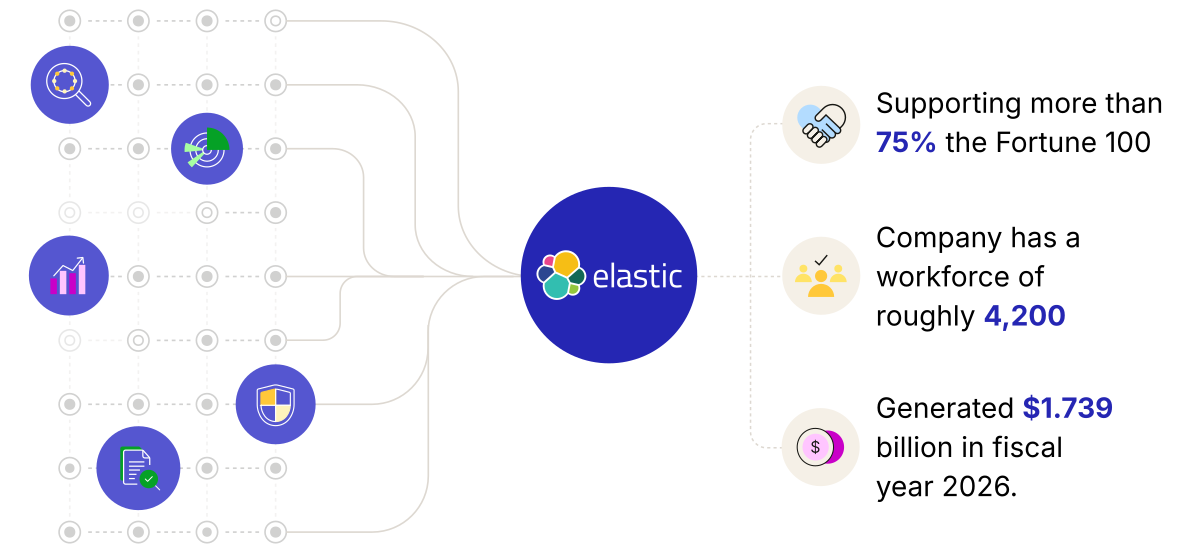
Elastic is a mid-sized global technology company that builds software to make data usable in real time and at scale for search, AI, observability, security, and analytics. Supporting more than 75% the Fortune 100, the company has a workforce of roughly 4,200 generated $1.739 billion in fiscal year 2026.
As Elastic’s legal needs evolved, its Legal team recognized the opportunity to build a more mature, auditable, and cost-efficient eDiscovery function in house. The team needed a platform that could support legal hold, preservation, review, and compliance across a modern technology environment without adding unnecessary complexity.
Elastic selected Casepoint through a competitive RFP process focused on capabilities, not vendor familiarity. With Casepoint, the team gained a fit-for-purpose platform that worked with its Google and Slack environment, supported a more dependable legal hold process, and gave the legal team more control over its data.
The value quickly extended beyond the original eDiscovery and legal hold use cases. Elastic used Casepoint to reduce outside costs, support DSAR work, convert contract-related email data for AI-assisted analysis, and work with a responsive partner that helped the team solve problems quickly and securely.

As we grow and mature, there was a need for us to be able to handle eDiscovery ourselves because the cost of sending it out is astronomical.

The Challenge
Elastic reached a point where its legal processes needed to evolve alongside the company’s growth. The team had relied on Google Vault, spreadsheets, DocuSign acknowledgements, and internal administrators to preserve data across systems like GitHub, laptops, Slack, and Google. Together, those processes highlighted the need for a more auditable, reliable, and scalable approach.
Foremost was eDiscovery and compliance across the whole Electronic Discovery Reference Model (EDRM). But legal hold helped make that inflection point more visible. Elastic needed a dependable way to track who was subject to a hold, confirm acknowledgements, guide administrators responsible for preserving data, and prevent relevant information from being lost when employees left and laptops were refreshed.
INDUSTRY INSIGHT
The Risk Many Legal Teams Still Accept
Much larger companies with billions in revenue often use manual methods for eDiscovery and legal hold. Yet the risk is evident. Lenander described this trend as a “risk threshold” where they don’t prioritize these functions.
Operating without an eDiscovery platform can be a gamble. A company’s exposure depends entirely on their risk appetite and the volume of their litigation docket.

The Solution
The Elastic team felt strongly about using a competitive RFP process.
It’s not necessarily the typical route when it comes to selecting a provider. But they wanted to eliminate the unconscious bias they feel everyone has, whether or not leaders want to admit it. And while they’ve used several tools, they believed the blind RFP process helped them find the best-in-class tool for their needs.
I don't want to know who the vendor is. I want to know, do they have the capabilities to meet my requirements?
The RFP had around 50 or 60 questions, but there were 20 that were really important for the team to move forward. For instance, Elastic uses Google and Slack, and not all eDiscovery tools work well in those environments. That kind of targeted approach was critical for the Elastic team’s mindset, all the way down to what they weren’t looking for.
"It’s easy for buyers to get distracted by the bright, shiny object, but so often those extra features are just overkill,” Lenander said. “Casepoint rises to the top because it gives us exactly what we need and nothing we don't. That focus makes the software incredibly user-friendly, and it means our costs are significantly lower than if we had bought a bunch of unnecessary extras.”
Conducting a blind RFP was invaluable. Anonymizing the submissions leveled the playing field and ensured our evaluation was based strictly on demonstrated capabilities rather than brand recognition.
The Results
Casepoint quickly proved valuable beyond the original legal hold and eDiscovery use cases. For Elastic, the platform created a more practical way to move data, reduce outside costs, and support internal analysis that would have otherwise required more manual work or outside help.
More Cost-Effective DSAR Support
Due to resource constraints and the complexity of a data subject access request (DSAR), Elastic chose to involve a third party for part of the work. Casepoint gave the team a practical way to export the data in the format the provider needed, allowing Elastic to pursue a more cost-effective path. “The quote we received from a firm to do that work was almost triple what we ended up paying,” Lenander said. “That’s a cost savings we can attribute to our ability to use Casepoint and to get that data out in an easy way.”
Operational Insight Without Outside Consulting
The team pulled 12 months of emails from contract aliases into Casepoint, converted them into PDFs, and uploaded them into an AI research tool. The analysis helped Elastic understand how it handled specific types of contracts and rethink assumptions about its contracting process. “We could have hired a consultant to do that for us,” Lenander said. “It probably would have cost us $25,000 or $50,000 to tell us what we were doing right and what we were doing wrong.”
Establishing a True Partnership
Implementing Casepoint was fast and seamless. The trainer walked the Elastic team through each step and helped with questions, explaining why things were set up a certain way. For instance, technical questions about how to hook up Casepoint to Slack and Vault were handled so connections were established easily.
“Casepoint far exceeded expectations and became true partners; you weren't just a vendor,” Lenander said. “Early on, we came to you with two business problems, simply asking if you had relevant whitepapers. You took the time not only to write those whitepapers, but also to build us an actionable business case. We couldn't ask for more. I can't think of any other vendor who has gone that far for us."
That support continued after implementation. When Elastic reached out with questions about something that had not worked as expected, the response was thorough and constructive.
"With a lot of vendors, when something goes wrong, you may get a dismissive response like, 'Sorry, you didn't use the tool correctly,'” Lenander said. “That was never our experience here. Casepoint's willingness to take real ownership and support us through challenges made a huge difference."
“I feel confident sharing feedback because I know your teams take it seriously. You actively work to build our requests into the product roadmap and find a solution. That level of commitment is huge.”
A More Controlled, Cost-Efficient Way To Work
For Lenander, the broader value of Casepoint came down to giving legal teams a more controlled way to manage data without unnecessary cost or complexity. Even in environments with heavier litigation demands, she said, the right platform can quickly justify itself by reducing hosting costs, centralizing access, and giving outside counsel a secure place to work without sending data through email.
"A platform like this pays for itself almost immediately,” Lenander said. “Just three months of hosting fees covers the cost of the tool, all while dramatically improving security by eliminating the need to send sensitive data over email."
Practical Impact: How a Centralized Platform Helps Legal Teams
-

Controlled Access
Give internal teams and outside counsel a secure place to review and collaborate.
-

Less Data Movement
Reduce the need to send sensitive legal data through email or move files between tools.
-

Cost Discipline
Avoid unnecessary hosting costs, outside handoffs, and overbuilt workflows.
Categories:


