
Overview
The company is a leading energy provider that serves millions of customers in the United States. Generating more than $25 billion in annual revenue, it is ranked within the top 150 on the 2025 Fortune 500 list.
The goal was to switch from Nuix to the Casepoint platform within a five-month time frame. The company’s team also wanted to consolidate its tech stack, take advantage of advanced cloud collection capabilities, and adopt a modern AI-based tool.
Casepoint completed the initial implementation within three months and provided ongoing support, including biweekly status reports, workflow consultation, and hands-on training. From validation through early production, Casepoint focused on preserving processing fidelity while introducing automation that reduced manual effort across review and production.
Over three years, the deployment scaled to meet growing demand and proved its value in live litigation: the platform accelerated rolling productions in a high-volume class-action matter, enabled faster, more defensible deliverables, and supported a roadmap of customer-driven enhancements.
The Challenge
The Fortune 150 company wanted to consolidate its technology stack and not renewing its contract with Nuix within five months of initiating onboarding. So the team came to Casepoint with a deadline for achieving their goals.
Reducing their tech stack was an important motivator for the company’s legal operations team. They wanted more control over their data within a single platform that offers cradle-to-grave management — a single source to operate more efficiently and save money.
Advanced functionality throughout the data process was key. For instance, the company liked the Casepoint platform’s cloud collection capabilities to connect easily to their Microsoft 365 tenant and stay within the platform for review before sending data to outside counsel. The team also wanted a modern AI-based tool.
They voiced their pain points and expectations along with their specific timeline.
The Solution
Casepoint initiated the implementation process right away, which was completed within three months, followed by a period of post-implementation support that included biweekly status reports, workflow consultation, and hands-on training. From day one, the focus was twofold: preserve processing fidelity compared to the customer’s prior toolset and reduce manual effort across production workflows.
Differences Between Nuix and Casepoint
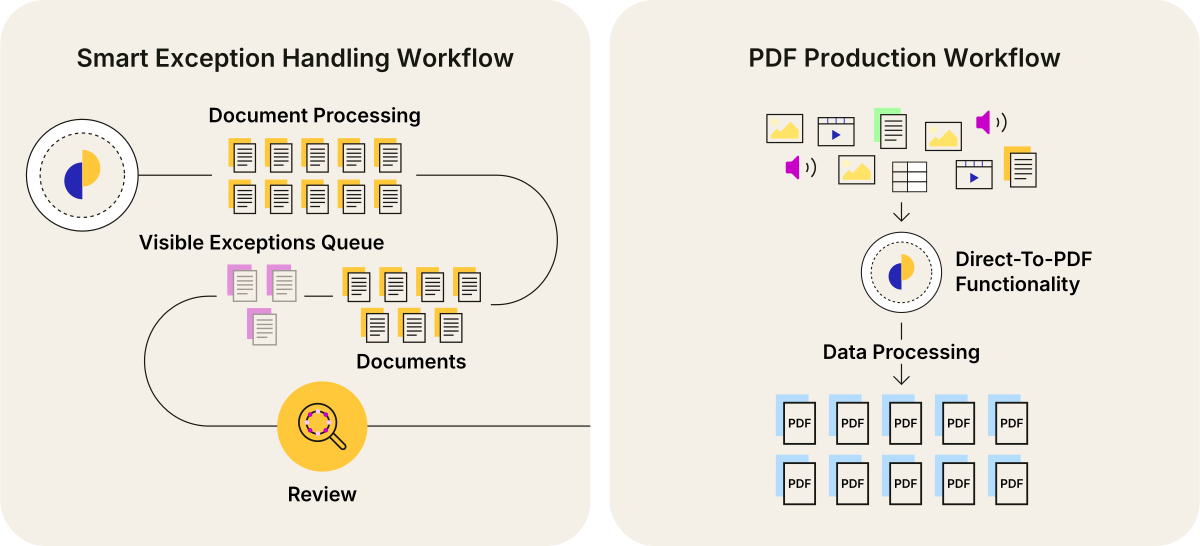
A key priority for the customer was ensuring they weren’t downgrading their tech. They noticed a difference in how Nuix and Casepoint processed data. For example, Nuix showed 10 documents while Casepoint reported seven, but the Casepoint team investigated and found that the platform flagged the remaining three items as exceptions, placing them in a separate exceptions queue for review. They weren’t missing — Casepoint made exception handling explicit, surfaced items that required human review, and prevented problematic files from silently slipping through. Nuix also flagged exceptions, but it was not obvious to users that the three documents in question had been processed properly.
What originally raised questions actually demonstrated how the Casepoint platform’s processes and technology are unique in the industry. Flagging errors allowed the customer’s team to act on items that they previously weren’t seeing in the same way. The results were more complete and helped the company see relevant information easily and quickly.
Reducing Time Spent on PDF Productions
The company produces a lot of data in PDF form. Previously, each production required a two-step process: documents were first exported as TIF images, then converted to PDF before delivery. This multi-step workflow was time-consuming and prone to manual errors.
Casepoint streamlined this by custom building direct-to-PDF functionality, allowing users to produce documents straight to PDF or media without the intermediate step. In practice, this automation eliminates the need to handle multiple export formats, reduces the chance of errors, and frees the team from repetitive manual tasks.
The Results
-
Time and cost savings with AI features and workflow automation
-
Review and production improvements applied to class-action matter
-
Successfully avoided renewal of the Nuix contract
-
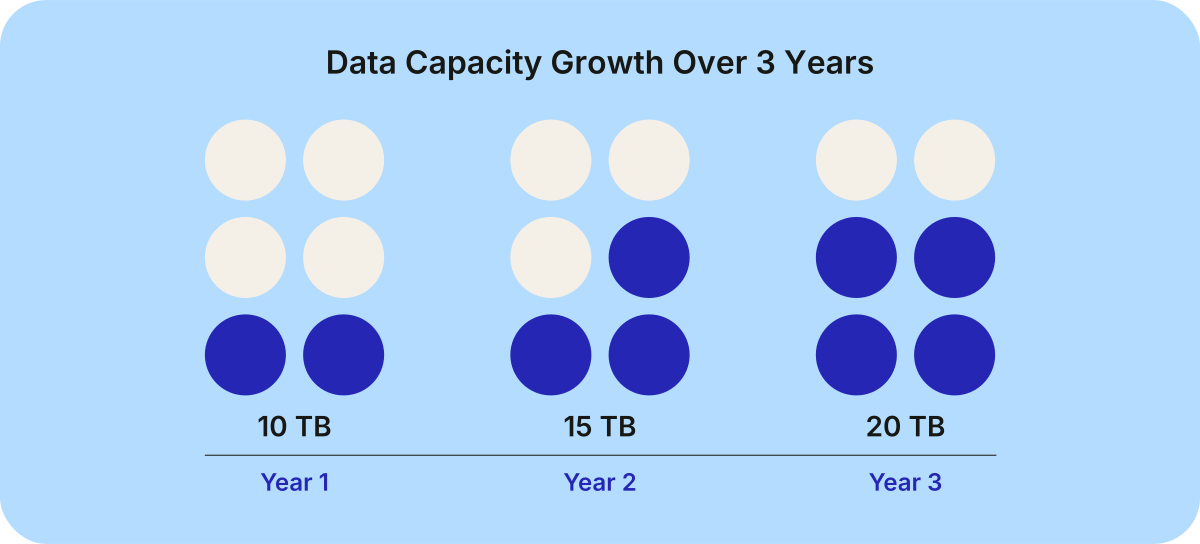
Data capacity growth over three years: 10 TB (year 1), 15 TB (year 2), 20 TB (year 3)
-
Several customer-driven feature requests were implemented
Automation and Workflow Improvements Supporting Active Litigation (Class Action)
The customer relied on Casepoint for a high-volume class-action matter where speed, defensibility, and handling of messy exports were critical. CaseAssist AI and advanced search surfaced high-value documents first, enabling the review team to prioritize and meet production deadlines. Email threading, deduplication, and automated privilege handling reduced the set of documents requiring manual review and simplified productions. When exported containers contained infected or problematic files, Casepoint’s exception flagging and quarantine workflow prevented processing errors and kept the review pipeline moving without introducing risk.
Because the team could produce directly to PDF and withhold/redact privileged information and metadata automatically, several production cycles that previously required manual intervention were shortened or eliminated. This accelerated deliverables in the class-action matter and reduced risky, repetitive tasks for reviewers.
Top Platform Features in Use
-
AI triage with CaseAssist surfaced the most relevant documents first, helping reviewers prioritize material and meet production deadlines
-
Email threading and deduplication grouped conversations and removed redundant items, reducing review volume and saving staff time
-
Automated privilege and metadata controls withheld or redacted privileged content automatically, eliminating manual placeholder handling and reducing errors
-
Direct-to-PDF production streamlined exports, removing the previous two-step workflow (TIF to PDF) and shortening production turnaround
-
Exception handling and container quarantine flagged problematic files before processing, ensuring review integrity and preventing downstream errors
Partnership Outcomes
Centralizing workflows on Casepoint produced both operational and strategic benefits.
-
Capacity growth to meet demand
-
Elimination of legacy licensing dependency
-
Faster and more defensible productions in active litigation
-
Collaborative product relationship that continues to deliver customer-driven enhancements
Categories:


