
AI is already a major part of legal and FOIA work. In many organizations, adoption has moved faster than governance and operating controls.
Skepticism is growing. After all, legal teams keep hearing about how vendors, law firms, and services providers are AI-enabled or AI-friendly, but the reality is that those labels carry less weight than they did even a year ago.
How should they proceed? Before deploying AI, legal and FOIA leaders should be able to answer five foundational questions. Drawn from interviews with dozens of senior practitioners across corporate legal departments, federal agencies, and law firms featured in the AI modernization whitepaper, these questions focus the discussion on workflows, boundaries, verification, and measurable value.
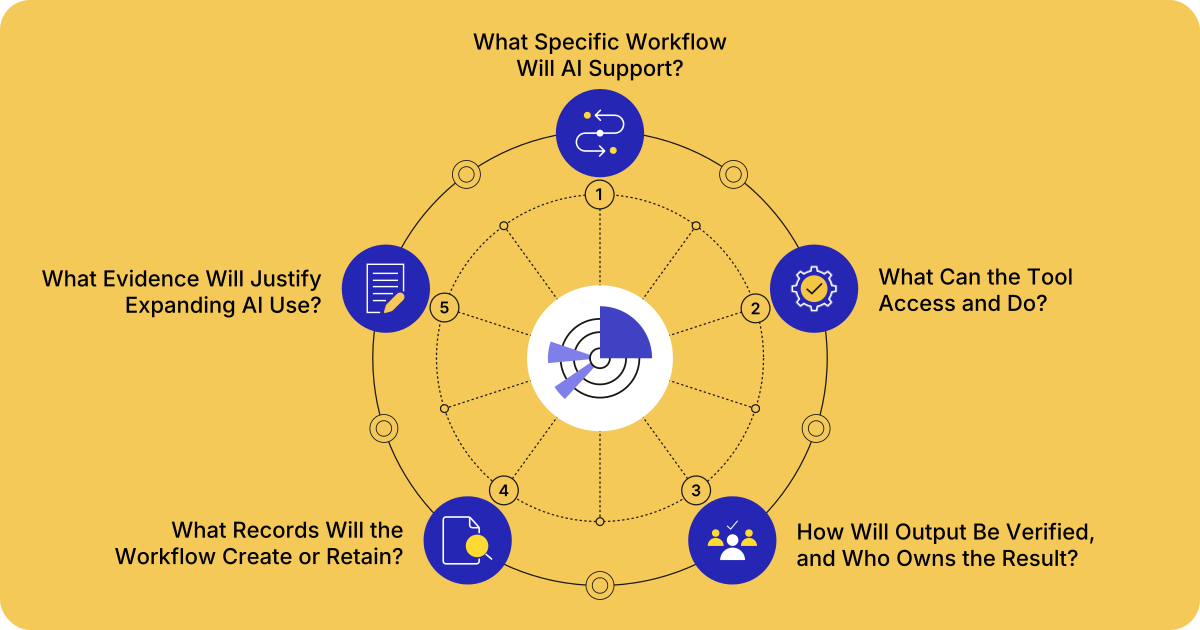
1. What Specific Workflow Will AI Support?
Start with the work, not the tool.
AI is a stronger fit when the task is bounded and the source material is known. The output should be reviewable, and a person should remain accountable for the result. That makes uses such as summarization, routing, and first-pass analysis stronger starting points than privilege decisions, final redactions, or production calls.
The point is not to avoid higher-value legal work forever. It is to build AI maturity in workflows where the team can learn safely, document what works, and expand from a stronger foundation.
Before moving forward, define what should improve and how the team will measure it. A use case is only clear when the task, expected outcome, and accountable reviewer are understood.
2. What Can the Tool Access and Do?
AI risk begins with what the tool can access and do. Before deployment, teams should define where the tool will operate, which information it may use, and which actions remain off-limits.
Legal AI depends on the structure around the model: the workflow it supports, the data it may rely on, the actions it is allowed to take, the review required before output is used, and the record that remains after the work is done.
Teams should also expect vendors and internal owners to explain where data goes, how activity is logged, and what security or authorization requirements apply.
3. How Will Output Be Verified, and Who Owns the Result?
AI output should be checked before it affects legal or FOIA work. The level of review may vary by risk, but every workflow needs a clear verification path and a person accountable for the final result.
Poor output is easy to reject when it is obviously wrong. The more difficult problem is fluent, confident, plausible output that looks right until someone tests it against the source material.
Legal teams should define how output will be checked before AI is used on live work, not after a risky result appears.
Verification also needs an owner: someone responsible for accepting, rejecting, or correcting the result and documenting the decision when risk requires it.

4. What Records Will the Workflow Create or Retain?
AI can create prompts, summaries, drafts, recommendations, and other materials inside systems legal and FOIA teams already use. Before those materials enter a hold, production, FOIA response, or investigation, teams should decide how they will be handled.
Many litigation hold policies, records schedules, and FOIA workflows were written for human-authored documents in known repositories. They were not built for AI-generated summaries, query histories, draft analyses, or prompt-and-response files that may be stored automatically.
Legal and FOIA teams should define AI record treatment before those materials appear in a collection, production, or request response.
That includes deciding what must be retained, connected to source records, reviewed, produced, withheld, logged, or defended.
5. What Evidence Will Justify Expanding AI Use?
AI can save time while adding costs for validation, training, governance, storage, and vendor oversight. Before expanding a workflow or adding licenses, teams should evaluate the full value of the deployment.
The better operators are measuring AI value more carefully. They are looking beyond license cost and estimated hours saved.
They are asking whether AI improves throughput on defined tasks, whether output quality is stronger or more defensible, and whether the organization can now do work that was previously too slow, expensive, or impractical to perform at scale.
Expansion should depend on those results and on whether the workflow’s verification, records, security, and accountability controls are working.
From 5 Questions to AI Accountability
Clear answers to these five questions give legal and FOIA teams a stronger foundation for deploying AI. They also expose where governance, verification, records, security, or ownership gaps must be addressed before use expands.
These questions are only a starting point. The From AI Hype to AI Accountability whitepaper draws from conversations with practitioners across corporate legal departments, federal agencies, and law firms to examine where AI is working, where governance gaps are emerging, and what teams need to build more controlled, verifiable, and defensible workflows.
Learn what practitioners said about AI use, verification, records, federal constraints, and responsible expansion.

Author
Director of Sales Engineering
Kevin Albert serves as Director of Sales Engineering at Casepoint. He leads the sales engineering function, aligning technical strategy, resources, and solution design with customer requirements and contractual obligations. He partners closely with sales, product, and operations to guide complex engagements, support demos and evaluations, and serve…
Categories:


